I’m a big fan of holistic design processes, so when I was tasked with “civil site design” for my senior capstone project at IIT, I saw it as my last opportunity to be unrealistically creative before getting a job in the “real world”.

The site is a real, existing dormitory on the IIT campus that is in need of renovation or demolition, at some point in the future. The project is the hypothetical demolition and construction on that site with a provided architectural model that was designed by students in the architectural program.

After consideration of applicable codes, standards, and owner requirements, it was determined that 8 buildings would arrange on the site nicely while leaving ample room for additional amenities. Some of those amenities are commercial space for eating and shopping for the surrounding community, plus greenspaces and gardens. This is a dramatic paradigm shift from what is common in this area of Chicago; tall fences, division, and exclusion.
Following Dirk Lohan’s guideline for campus planning (updated from the original plan set forth by Mies van der Rowe), a staggered layout for the buildings is proposed that does not keep buildings in strict alignment, but instead creates a guided flow through the site, depicted by red arrows below.
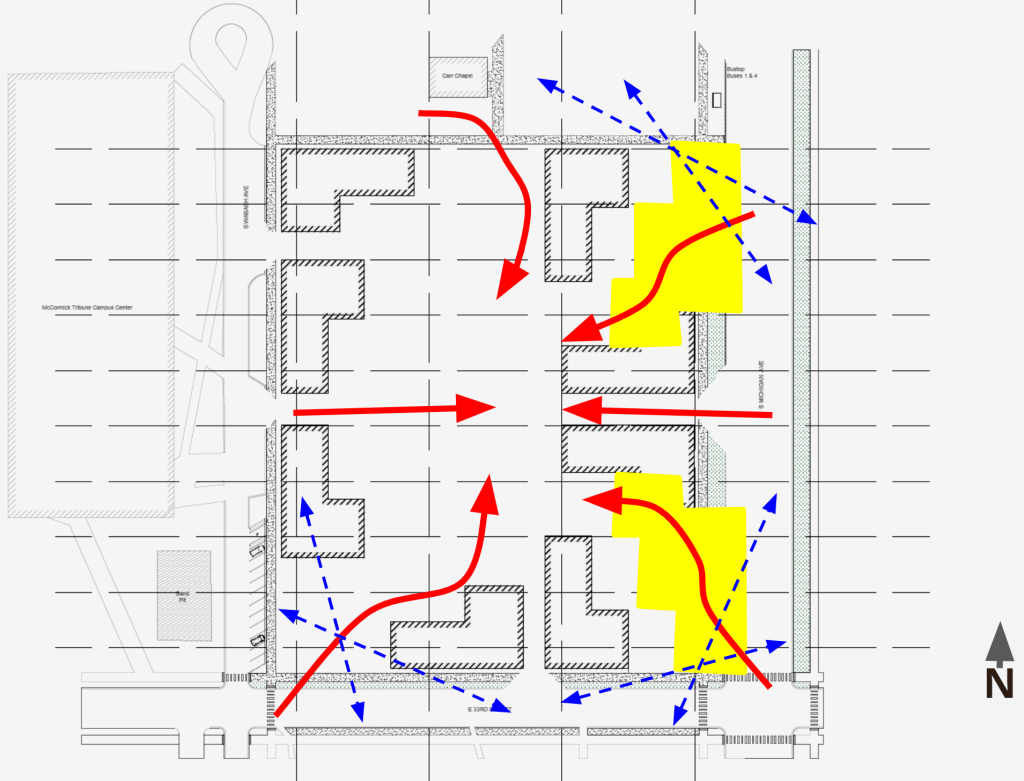
Highlighted in yellow, commercial areas on Michigan Ave frontage invite the surrounding community to the campus to benefit from publicly available amenities such as shopping and greenspaces. The corners of the site are chamfered to soften the sharp right angles of the Chicago street grid and provide eyelines to other portions of the campus.
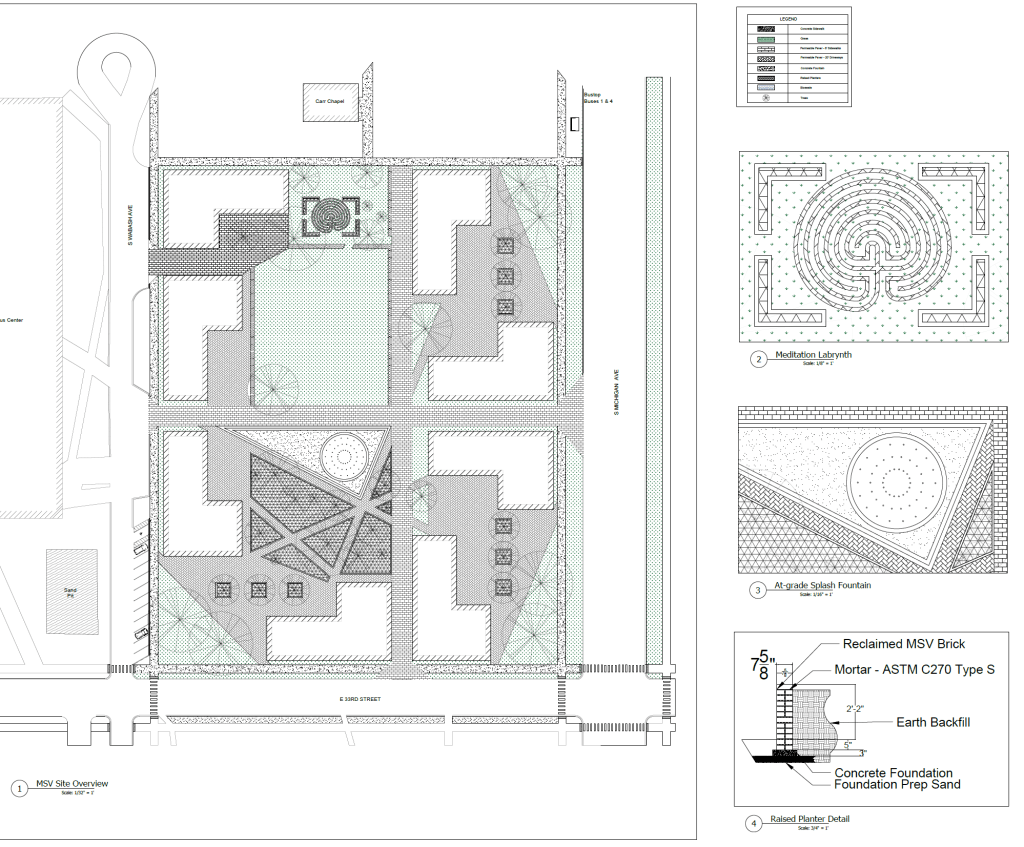
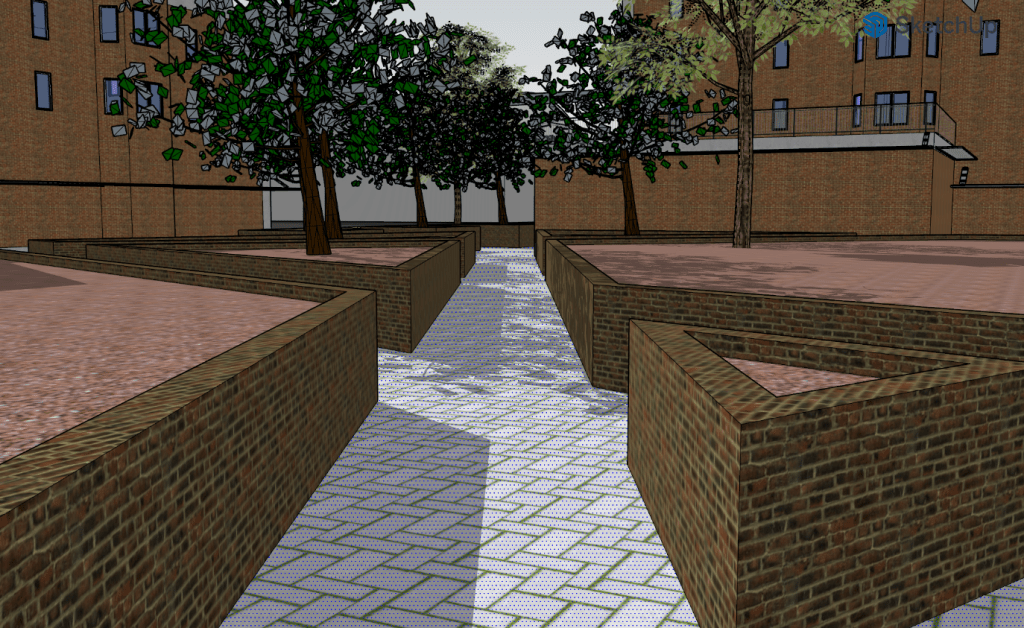
On the southern portion of the central greenspace, sidewalks crisscross providing direct access to other areas of interest. They are bounded by 2’ high raised planters on each side and are constructed of reclaimed brick from the original building. This area provides lush landscaped areas of native planting that providing shade, color, and texture- inviting a visitor to slow their progress, and perhaps stop and sit on one of the benches made from the trees harvested from the site during demolition.
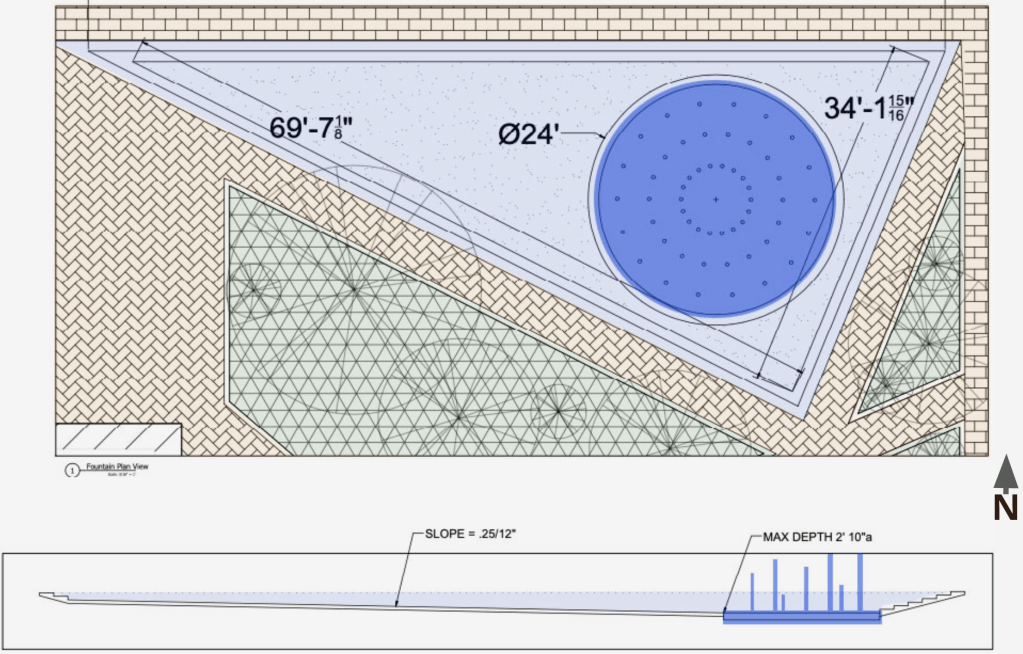
A large triangular concrete area is central to the site that consists of long shallow steps down to a slope that terminates in a grade-level fountain. The steps are an ideal place to take lunch on a beautiful day, and the fountain provides an area where one can take off their shoes to cool in the heat of the day while the splash of water against the concrete is just enough to cover the sound of nearby traffic.
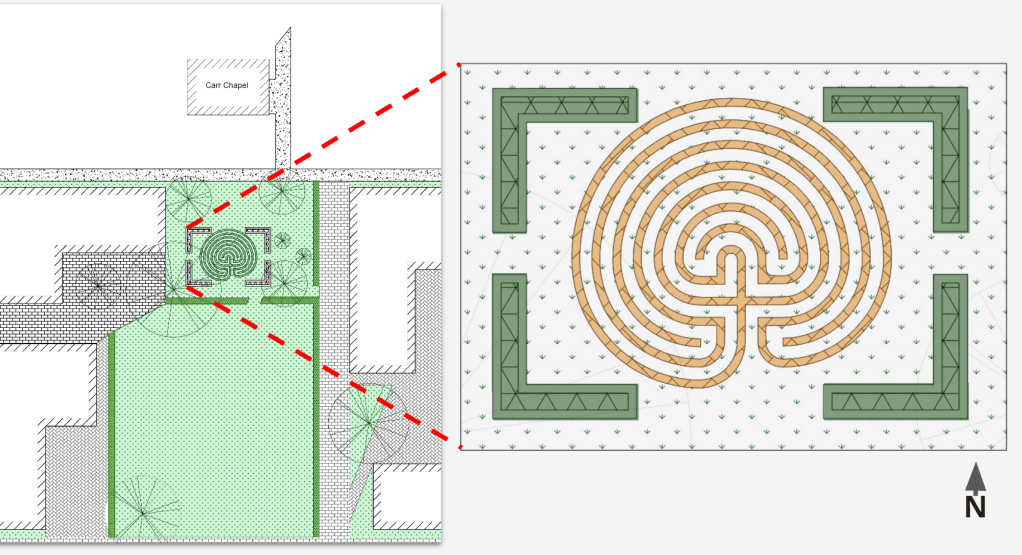
The central area of the greenspace is open grass providing an outdoor flex-space area bounded on three sides by 8’ wide bioswales that will help catch a stray soccer ball that sneaks past a goal-post. The northern end of the green space is reserved for meditation and contemplation. Raised planters border a mirrored footprint identical to nearby Carr Chapel and surround a 7-course “Classical” labyrinth pattern made from paver bricks at grade-level.
The stormwater plan has building downspouts empty into the provided 473’ of bioswale. In the rare event of bioswale overflow, water is directed to the 5,900 cubic feet of volume provided by the subgrade fountain depression which will store water and release it to the Chicago stormwater system gradually. Additional stormwater considerations include permeable paving throughout the site totaling 74,000 square feet, plus expected evapotranspiration from the 21,000 square feet of grass and 37+ trees.
Site Lighting uses Darksky approved fixtures, which prioritize minimization of sky glow and light trespass. Energy efficient LED fixtures are all color balanced to a warm 3000K and have a minimum CRI (Color Rendering Index) of 70. Nighttime safety is based around sufficient illumination and accurate color rendering that lets people know they are always visible in every corner of the site. The glare of such illumination is reduced by the contrast created by highlighted areas of architecture and landscaping.
 Collection of Found Objects
Leave a comment